A hybrid-electric grand-touring aircraft under development, designed around a spacious pressurized lounge, shared experiences, and mission-flexible travel. Powered by our proprietary, patent-pending EELAS™ emergency energy and landing intelligence system.
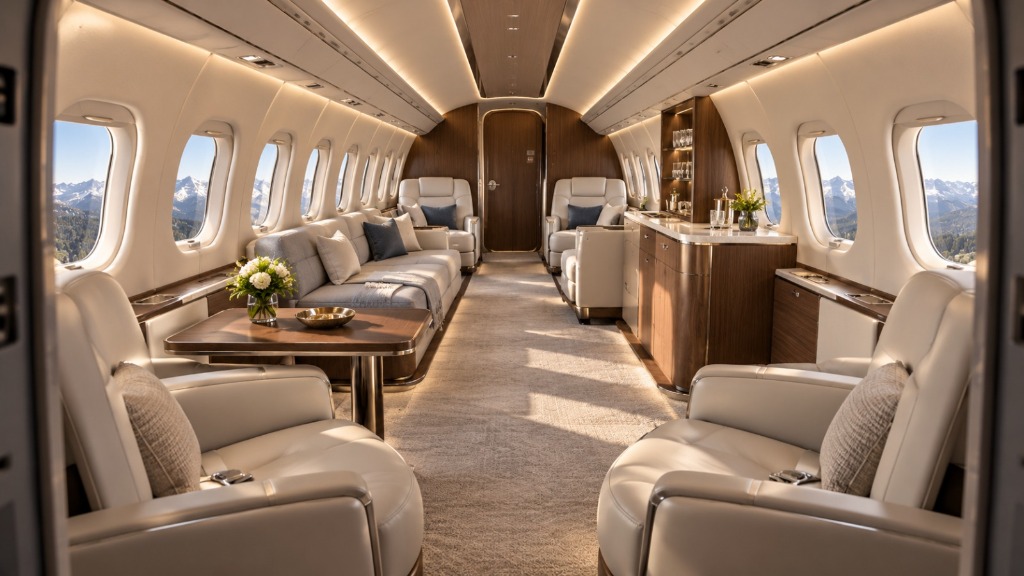
The SS190 concept prioritizes conversation, comfort and useful space. A lounge-style interior, conventional rounded windows, an enclosed lavatory and compact refreshment service support a more social journey. Cabin layouts and final seating capacity remain subject to engineering and approval.
Armchair and narrow divan arrangements designed for natural conversation rather than rigid commercial rows.
Generous longitudinal allowance providing comfortable standing height (~6.5 ft centerline) and clear circulation.
Dedicated aft lavatory partition, compact galley/bar, and dedicated wardrobe/baggage accommodations.
Structural integrity ensured with proven, supplier-supported aircraft window assemblies; solid roof and belly.
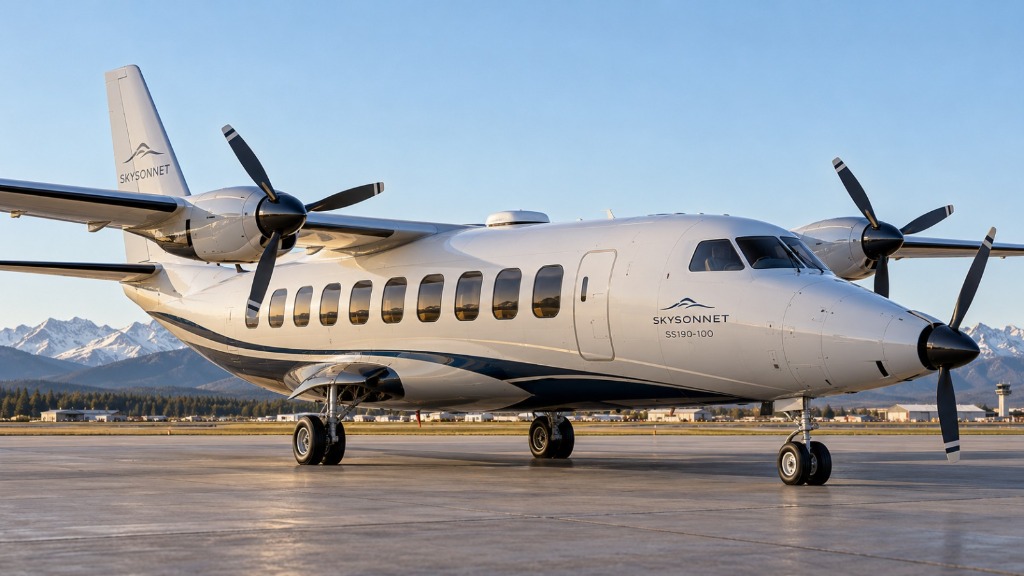
The current architecture combines two wing-mounted Jet-A compression-ignition engines with a centerline electric propulsor. Electric power is being developed for taxi, takeoff assistance and selected abnormal-condition support. Installed performance and operating capabilities remain under study.
Two wing-mounted RED A03-family Jet-A compression-ignition engines provide efficient primary cruise power (~500 shp takeoff / 460 shp maximum continuous rating per engine under study).
Centerline electric motor (~350-kW installed class) providing electric forward taxi, takeoff climb assistance (~300 kW normal command), and emergency energy-management headroom.
About 125 kWh gross energy storage arranged in two physically separated ~62.5 kWh channels (~800 V nominal) in protected center-fuselage underfloor bays near the center of gravity.
Emergency Energy & Landing Advisory System
In hybrid-electric aviation, nominal battery capacity alone does not guarantee a safe landing. An emergency runway may be nearby yet unreachable due to ridges, winds, or approach geometry. SkySonnet's proprietary, patent-pending EELAS™ continuously models flyable recovery trajectories, predicts forward risk along the route, and proactively schedules battery reserves before an exposed corridor.
Continuously evaluates which specific runway ends are genuinely flyable under current aircraft drag, wind, surviving propulsion, and obstacle constraints. Replaces high-stress manual pilot calculations with verified, terrain-clearing approach trajectories.
Scans the planned flight path ahead to detect future "energy deserts"—mountain passes, overwater legs, or remote stretches where diversion options disappear—and determines the exact deliverable energy buffer required to maintain continuous safety coverage.
Schedules in-flight battery charging and thermal conditioning before the aircraft enters an exposed route segment. Ensures the emergency reserve is primed and thermally capable without taxing primary propulsion efficiency or essential aircraft services.
A review of 30 historical NTSB investigation records (1994–2026) reveals concrete failure modes that conventional aviation cannot resolve. EELAS paired with independent electric energy addresses these exact shortfalls.
A twin-engine aircraft experienced a cruise power loss followed by second-engine failure during diversion, touching down in a field just 500 feet short of the threshold.
Both piston engines failed simultaneously in the traffic pattern due to fuel selector starvation, crashing into trees 0.5 miles short despite usable fuel remaining in auxiliary tanks.
During an in-flight emergency, viable alternative landing sites were available within gliding distance but were not promptly identified or committed to during high pilot workload.
The pilot reported needing just 200 additional vertical feet to clear a mountain pass before an off-airport landing ensued in rugged terrain.
Replaces cockpit crisis calculations with ranked, wind-adjusted runway options.
Turns forced off-airport crashes into controlled, survivable runway arrivals.
Defensible patent-pending energy coordination software native to SkySonnet aircraft.
Watch EELAS evaluate real-time runway reachability, dynamic glide/powered contours, and pre-gap energy preparation as an aircraft navigates the Rocky Mountain Continental Divide or California coastal corridors. Backed by our indexed 86,223-airport aeronautical database with live CTAF/Tower frequencies and runway dimensions.
All values below are qualified targets and preliminary engineering study values under current evaluation, not certified performance or released production specifications.
Under study alongside 8-seat executive layouts; plus two flight-crew positions.
Passenger cabin packaging allowance including lavatory and service circulation.
Two wing Jet-A compression-ignition engines plus one centerline nose electric propulsor.
Preliminary fast cruise objective; 150–165 KTAS economy cruise target.
Upper cruise analysis point; ~8,000-ft cabin-altitude target at FL250.
High wing study baseline with aspect ratio ~9.42 derived from span and area.
Maximum gross-weight study boundary; ≤12,500 lb equipped-aircraft objective.
Usable fuel trade studies with a 600-gallon physical wing-tank volume objective.
~850 nm full-cabin regional class; ~1,400 nm touring class with payload traded for fuel.
Overall fuselage packaging target with ~6.5 ft centerline interior standing height.
Production-study direction; nose-electric forward taxi for ramp efficiency.
Proprietary patent-pending emergency energy and landing trajectory management software.
Starlink satellite internet and cabin Wi-Fi are part of the planned cabin offering, subject to aircraft-specific integration, service availability and approval. An optional camera-fed digital ceiling is being explored to bring a live sky view into the cabin without a physical skylight.
High-speed, low-latency satellite internet paired with cabin Wi-Fi keeps every passenger seamlessly connected for productivity, streaming, or communication en route.
An optional camera-fed digital ceiling is being studied to project live upward sky, cloudscape, or night views without introducing structural or pressurization skylight openings.
A continuously rounded pressure shell with proven rounded side windows, maintaining structural integrity, robust bird-strike protection, and certifiable pressure margins.
SkySonnet has established a preliminary architecture and is evaluating cabin packaging, mass, propulsion integration, software algorithms, and performance. Supplier data, detailed design, testing and certification work remain ahead. Images depict the design concept, not a production aircraft.
SkySonnet is evaluating early investor and strategic partner inquiries for its pre-seed development round. Connect with our project team to review concept documentation, discuss the SS190-100 aircraft, and explore our proprietary EELAS™ software.
Submit your contact details to connect with the project team and receive concept development updates, aircraft specifications, and EELAS™ software materials.